Descrizione
Cinema Capture in an RF-Mount, Mirrorless Form
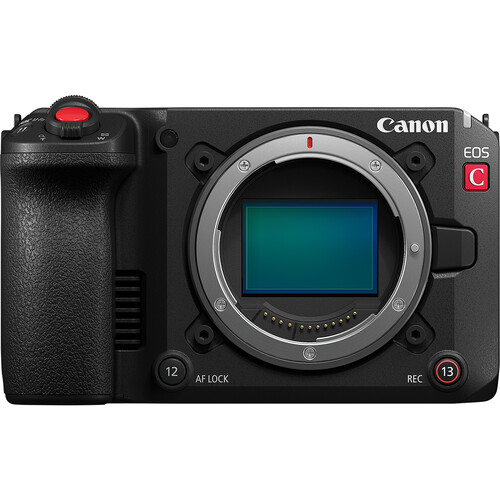
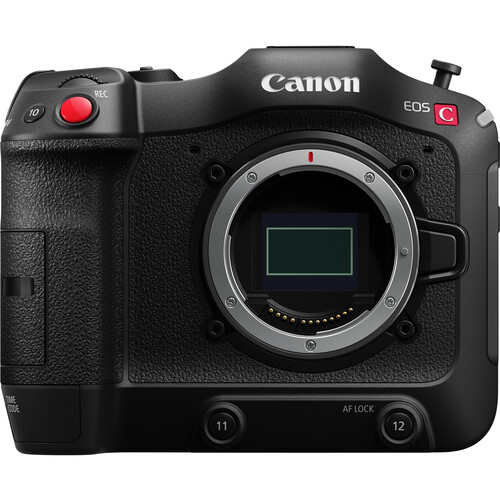
Incorporating key Cinema EOS video tools in a mirrorless-style body, the Canon EOS C70 Cinema Camera features a Super35 DGO (Dual Gain Output) sensor for capturing nuanced images with up to 16+ stops of high dynamic range. The EOS C70 is the first Cinema EOS camera with an RF mount that enables you to use Canon’s line of fast, reliable RF lenses with advanced coatings and image stabilization.The innovative DGO system combines two separate gain readings for each photodiode on the sensor, emphasizing saturation in bright areas of your image and lowering noise in darker areas.
Video resolutions include DCI 4K capture at rates ranging from 23.98 to 60 fps, plus high-speed options up to 120 fps in UHD 4K and 180 fps in cropped 2K. Pro video functions include unlimited video recording, Dual Pixel CMOS AF autofocus control, a motorized ND filter wheel tucked into the shallower RF-mount flange depth, a BNC timecode input/output connector, and built-in dual mini-XLR audio inputs.
Exceptional Image Quality
Canon Super35 Dual Gain Output (DGO) Sensor
Canon’s next-generation Super35 Dual Gain Output (DGO) Sensor offers a dynamic range of up to 16+ stops and includes Canon’s exclusive Dual Pixel CMOS Autofocus technology. The DGO Sensor generates a high dynamic range and maintains low-noise levels by reading out each pixel with different gains. It combines images using pixels shot with a saturation-prioritizing amplifier for bright areas, and a lower-noise, noise-prioritizing amplifier for darker areas.
DIG!C DV7 Image Processor
Canon’s DIG!C DV7 image processor takes the extensive raw information captured from the imaging sensor and processes it for output. The DiG!C engine is also the driving force behind features such as high frame rate recording, Dual Gain Output (DGO) Sensor, Dual Pixel Autofocus, HDR (PQ) output, Electronic Image Stabilization, and proxy recording.
Canon Log 2 and 3; PQ and HLG Recording
The EOS C70 supports both the full dynamic range Canon Log 2 and the more workflow-friendly Canon Log 3 gamma. Canon Log formats are designed to reproduce the entire tonal range of its CMOS image sensor. Turn to a log post-production workflow when you’re seeking a higher dynamic range, improved highlights and shadow retention, and increased grading flexibility. Note that while Canon Log 2 offers the largest dynamic range and image detail, the most post-production flexibility, and the full dynamic range of the sensor, it typically will require more time spent in color correction.
For users seeking most of the benefits of a log workflow but with reduced turnaround times, choose the Canon Log 3 alternative with only a slightly reduced dynamic range of 14 stops.
Highly Adaptable Shooting Style
RF Lens Mount
- A built-in RF lens mount lends the EOS C70 compatibility with Canon’s expanding line of high-performance RF-mount lenses.
- With a short flange distance, the RF mount helps to noticeably reduce the camera body’s depth, resulting in a more compact design.
EF Lens Compatibility with Optional Adapter
To provide greater flexibility in lens choices, the EOS C70 camera is also compatible with the separately available EF-EOS R 0.71X EF to RF lens mount adapter. This adapter converts your full-frame lenses to Super35 format while also providing a handy aperture speed boost of around one stop The EF adapter passes EF lens data through the RF mount, providing full Dual-Pixel Autofocus and metadata information for select lenses. Additional compatible adapters include the EF-EOS R Canon Mount, Canon Control Ring Mount, Drop-In Circular Polarizer Filter Mount, and Drop-In Variable ND Filter Mount adapters.
Direct Touch Control
The EOS C70 features Direct Touch Control, enabling you to quickly and easily access your favorite menu settings through the fully rotatable LCD screen. Simply touch the 3.5″ screen to start/stop recording, set ISO/Gain, color temperature, and iris, and access other critical settings. Recording settings that are located in different menus can now be controlled with one hand, enabling on-the-spot changes even while operating the camera with one hand.
9 x 16 Vertical Capture
Use the 1/4″-20 tripod thread built into the grip to position the EOS C70 for vertical use when capturing images for digital signage or mobile device use. For easier viewing, the user interface can also be switched for vertical use.
Compact Design
The compact EOS C70 features a lightweight design with a built-in ergonomic grip. This smallest of the EOS bodies has two top shoe mounts and comes with a detachable handle and a mic holder.
Mini-XLR Audio Inputs
- Two mini-XLR inputs with phantom power and manual control dials provide professional audio recording options for the EOS C70
- The EOS C70 supports up to 4-channel audio using dual mini-XLR ports, an internal stereo mic, and a 3.5mm mic input
Built-In ND Filters
Designed specifically for the EOS C70’s short flange distance, a thin motorized ND filter unit enables users to quickly select up to 10 stops of neutral density – an especially handy feature for ENG shooters or when shooting in quickly changing lighting conditions.
Timecode Input/Output
A BNC connector on the front of the EOS C70 enables users to input and output timecode, making synching on multicamera shoots easier.
Dual Pixel CMOS Autofocus with Touch AF and Face Detection
- Another innovative EOS C70 feature is the Dual Pixel CMOS AF Technology, which uses each pixel on the CMOS sensor for both focus detection and image information, resulting in precision focusing and optimal image quality. The EOS C70 is also the first Cinema EOS camera to feature the EOS iTR AF X autofocus function featuring a head-detection algorithm developed using deep-learning technology.
- In Face Detection mode, this algorithm helps to improve distance measuring and tracking reliability, even when a subject turns their head to the side or back.
- The EOS C70 also features the innovative Dual Pixel Focus Guide, which provides both front- and back-focus information to let users know where to set the focus during manual pulls.
EIS with Coordinated Control
- To smooth out handheld shots, the EOS C70 is the first Cinema EOS camera to offer enhanced image stabilization with coordinated control. When used with an RF-mount lens and the EOS C70’s electronic IS, coordinated control optimizes hand-shake correction for even greater vibration reduction than that obtained with an EF-mount lens and electronic IS.
- When working in the 2K format, the EOS C70’s Super16 Digital IS improves performance by using the peripheral area around the center of the 4K sensor to stabilize the image.
Auto ISO/Gain Control
In another first for the Cinema EOS line, the EOS C70 can automatically adjust ISO and Gain Control using the DGO (dual gain output) to change gain smoothly, enabling users to concentrate on their framing instead of their aperture control when moving between locations with notable changes in light levels.
RC-V100 Support and LANC Compatible
The EOS C70 body’s remote LANC terminal enables remote control using the optional Canon RC-V100 unit. The RC-V100 provides full access to key functions like start/stop, shutter/gain adjustments, focus/iris/zoom settings, display settings, white balance, black gamma, and more.
Advanced Workflow Optimization
Dual SD Card Slots / Multiple Recording Options
Dual SD card slots on the EOS C70 enable simultaneous recording in different formats including 4K/HD and XF-AVC/MP4 options. The EOS C70 can also capture still photos when on standby in select video modes.
Log2/3 and Cube LUT Support
For greater flexibility during post-production, this camera also offers Canon’s Log 2 and Log 3 gamma modes, both of which provide an expanded dynamic range with excellent tonal reproduction for highlights and in low-light areas of your images. The EOS C70 also supports .cube 3D LUTs so you can get the most accurate color reproduction on both the LCD and your external viewing monitors
4K/2K Long GOP Support
The EOS C70 supports the higher-compression Long GOP for longer recording times at rates up to 4K60p. The inter-frame Long GOP compression detects differences between frames by referring to preceding and subsequent frames.